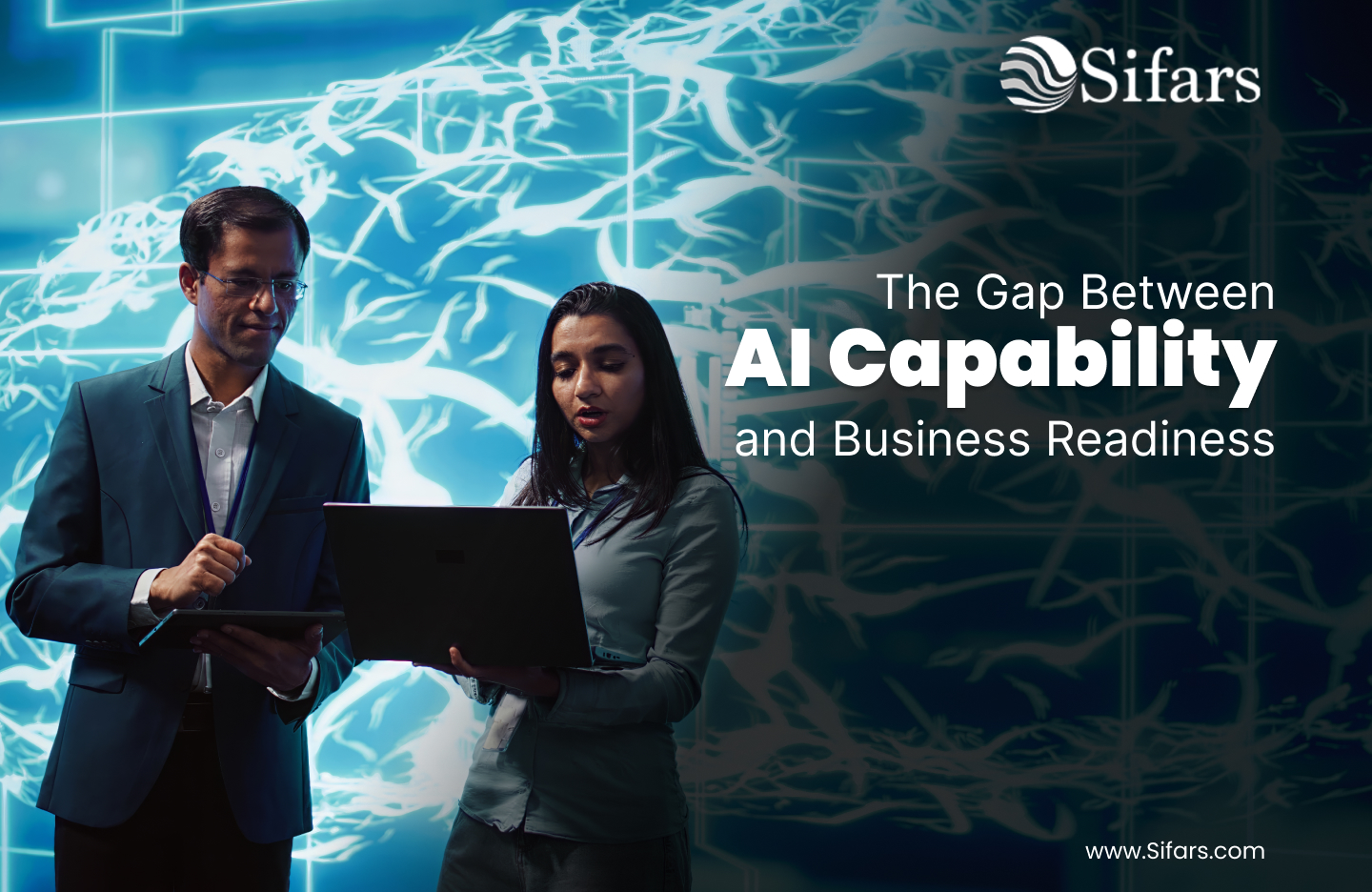
The Gap Between AI Capability and Business Readiness

The pace of advancement in AI is mind-blowing.
“Models are stronger, tools are easier to use and automation is smarter.” Jobs that had been done with teams of people can now be completed by an automated process in a matter of seconds. Whether it’s copilots or completely autonomous workflows, the technology is not the constraint.
And yet despite this explosion of capability, many firms find it difficult to translate into meaningful business impact any output from their AI programs.
It’s not for want of technology.
It is a lack of readiness.
The real gulf in AI adoption today is not between what AI can do and the needs of companies — it is between what the technology makes possible and how organizations are set up to use it.
AI Is Ready. Most Organizations Are Not.
AI tools are increasingly intuitive. They are capable of analyzing data, providing insights and automating decisions while evolving over time. But AI does not work alone. It scales the systems it is in.
If the workflows are muddied, AI accelerates confusion.
Unreliable Outcomes Of AI When Data Ownership Is Fragmented
Where decision rights are unclear, AI brings not speed but hesitation.
In many cases, AI is only pulling back the curtain on existing weaknesses.
Technology is Faster Than Organizational Design
Often, a similar PERT would be created for technology advances before it got to the strategy of Jilling produced with project and management findings.
For most companies, introducing AI means layering it on top of an existing process.
They graft copilots onto legacy workflows, automate disparate handoffs or lay analytics on top of unclear metrics. There is the hope that smarter tools will resolve structural problems.
They rarely do.
AI is great at execution, but it depends on clarity — clarity of purpose, inputs, constraints and responsibility. Without those elements, the system generates noise instead of value.
This is how pilots work but scale doesn’t.
The Hidden Readiness Gap
AI-business readiness is more of a technical maturity than frequently misunderstood business readiness. Leaders ask:
- Do we have the right data?
- Do we have the right tools?
- Do we have the right talent?
Those questions are important, but they miss the point.
True readiness depends on:
- Clear decision ownership
- Well-defined workflows
- Consistent incentives
- Trust in data and outcomes
- Actionability of insights
Lacking those key building blocks, AI remains a cool demo — not a business capability.
AI Magnifies Incentives, Not Intentions
AI optimizes for what it is told to optimize for. When the incentives are corrupted, automation doesn’t change our behavior — it codifies it.
When speed is prized above quality, AI speeds the pace of mistakes.
If the metrics are well designed; bad if they aren’t, because then AI optimizes for the wrong signals.
Discipline The Common Mistake Organizations tend to expect that with AI will come discipline. Basically discipline has to be there before AI comes in.
Decision-Making Is the Real Bottleneck
Organizations equate AI adoption with automation, which is only half the story if truth be told. It is not.
The true value of AI is in making decisions better — faster, with greater consistency and on a broader scale than has traditionally been possible. But most organizations are not set up for instant, decentralized decision-making.
Decisions are escalated. Approvals stack up. Accountability is unclear. In these environments, AI-delivered insights “sit in dashboards waiting for someone to decide what we should do,” says Simon Aspinall of the company.
The paradox is: increased smarts, decreased action.
Why AI Pilots Seldom Become Platforms
AI pilots often succeed because they do their work in environments where order is so highly maintained. Inputs are clean. Ownership is clear. Scope is limited.
Scaling introduces reality.
At scale, AI has to deal with real workflows, real data inconsistencies, real incentives and this thing we call human behavior. This is the point where most of those initiatives grind to a halt — not because AI ceases functioning, but because it runs smack into an organization.
Without retooling how work and decisions flow, AI remains an adjunct rather than a core capability.
What Business Readiness for AI Actually Looks Like
As organizations scale AI effectively, they focus less on the tool and more on the system.
They:
- Orient workflows around results, not features
- Define decision rights explicitly
- Align incentives with end-to-end results
- Reduce handoffs before adding automation
- Consider AI to be in the execution, not an additional layer
In such settings, AI supplements human judgment rather than competing with it.
AI as a Looking Glass, Not a Solution
AI doesn’t repair broken systems.
It reveals them.
It indicates where the data is uncertain, ownership unknown, processes fragile and incentives misaligned. Organizations who view this as their failing technology are overlooking the opportunity.
Those who treat it as feedback can redesign for resilience and scale.
Closing the Gap
The solution to bridging the gap between AI ability and business readiness isn’t more models, more vendors, or more pilots.
It requires:
- Rethinking how decisions are made
- Creating systems with flow and accountability
- Considering AI as an agent of better work, not just a quick fix
AI is less and less the bottleneck.
Organizational design is.
Final Thought
Winners in the AI era will not be companies with the best tools.
They will be the ones developing systems that can on-board information and convert it to action.
The execution can be scaled using AI — but only if the organization is prepared to execute.
At Sifars, we assist enterprises in truly capturing the bold promise of AI by re-imagining systems, workflows and decision architectures — not just deploying tools.
If your A.I. efforts are promising but can’t seem to scale, it’s time to flip the script and concentrate on readiness — not technology.
👉 Get in touch with Sifars to create AI-ready systems that work.
🌐 www.sifars.com

Related Posts

New York businesses are moving fast toward digital transformation. From startups in Brooklyn to enterprises in Manhattan, companies are investing in tailored technology to scale operations, improve efficiency, and stay competitive. This is where choosing the right custom software development...
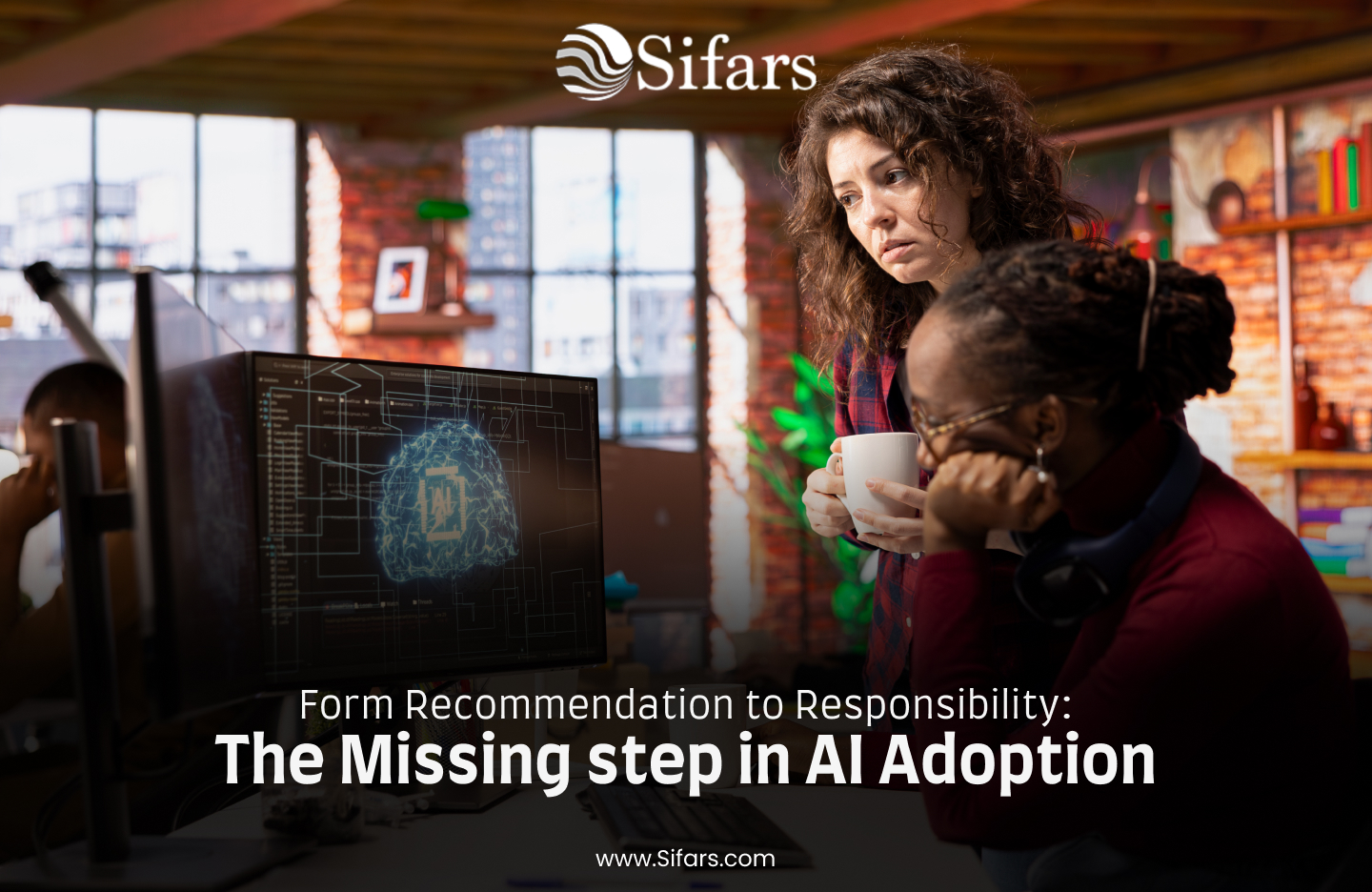
Most AI initiatives today are excellent at one thing: producing recommendations. Dashboards highlight risks. Models suggest next-best actions. Systems flag anomalies in real time. On paper, this should make organizations faster, smarter, and more decisive. Yet in practice, something crucial...

When AI projects go wrong, the diagnosis is usually the same: “The technology is too complex.” But in most organizations, that’s not the real problem. AI didn’t introduce complexity. It simply revealed the complexity that was already there. Many companies...
